
Virtual Book Launch & the Milky Way, finally!
Join me for poetry and photos on June 30th and get a glimpse of the night sky now

Greetings All,
You’re invited to the virtual launch of More Poemographs for Peace, my latest anthology penned by 22 poets in response to 30 of my photos. We’re gathering at 6 p.m. PDT on Tuesday June 30th to share an hour of photos and poems with each other and our friends and families. We’d love to have you join us. Please message me below for the Zoom link. All proceeds from the sale of the book benefit World Central Kitchen Gaza Relief and the ACLU. See below for links to purchase. Please help us spread the word. Thanks, and hope to see you soon.

P.S. You can read the first 30 pages of the book on Amazon by clicking “read sample” on the book’s purchase page.
And now for the Milky Way, finally!! The “season” began in earnest in mid-March, with the Milky Way rising in an arch in the East in the early morning hours around 5 a.m. my time. Over the course of the season, which is over by the end of October, the Milky Way’s rise moves gradually to the southeast, then south, then southwest, and over time loses the arch, rising straight up into the sky. Rising time also continues to creep into earlier hours. Currently it’s rising shortly after midnight, and is up all night, but visible only during the few hours of true dark/night we have in the Pacific Northwest, and 30 minutes or so of astronomical twilight on each end of night. When our twilight begins to decrease, our viewing time will increase in July and August, and then begins to decrease as we head toward the season’s end. In mid-October the Milky Way will be visible at 8 p.m. easily spotted from my house, weather permitting.
In these first months of the season, I need to travel to see the Milky Way, since I don’t have an eastern or southeastern view. And until yesterday, my efforts have been a bust. And I should say “our efforts” because I couldn’t pursue this hobby without my husband who has become my chauffeur, sherpa, and dark sky companion on our forays away from home. The Milky Way is only visible when the moon is not, and is also obscured by artificial light which impacts the skies for many miles around cities and towns. Our new moon camping trips in April and May were enjoyable, but the night sky was completely cloudy, and not nearly as dark as I thought it would be in those locations, and a group excursion in May was cancelled due to weather.
I was relieved that as our June Milky Way camping weekend approached the forecast was for clear skies. Friday night we arrived at Alder Lake, a reservoir with a campground run by Tacoma Power, located between Eatonville and Elbe enroute to Mt. Rainier. From the online map I knew our campsite faced the water, and though there were trees at its edge, I was planning to skirt around them to photograph the night sky. We arrived around 6 p.m. to find high bank waterfront, not low bank as I’d seen in photos (of the swim beach) with a chainlink fence and signs every 20 feet warning against jumping from the cliff into the lake! So much for my plan.
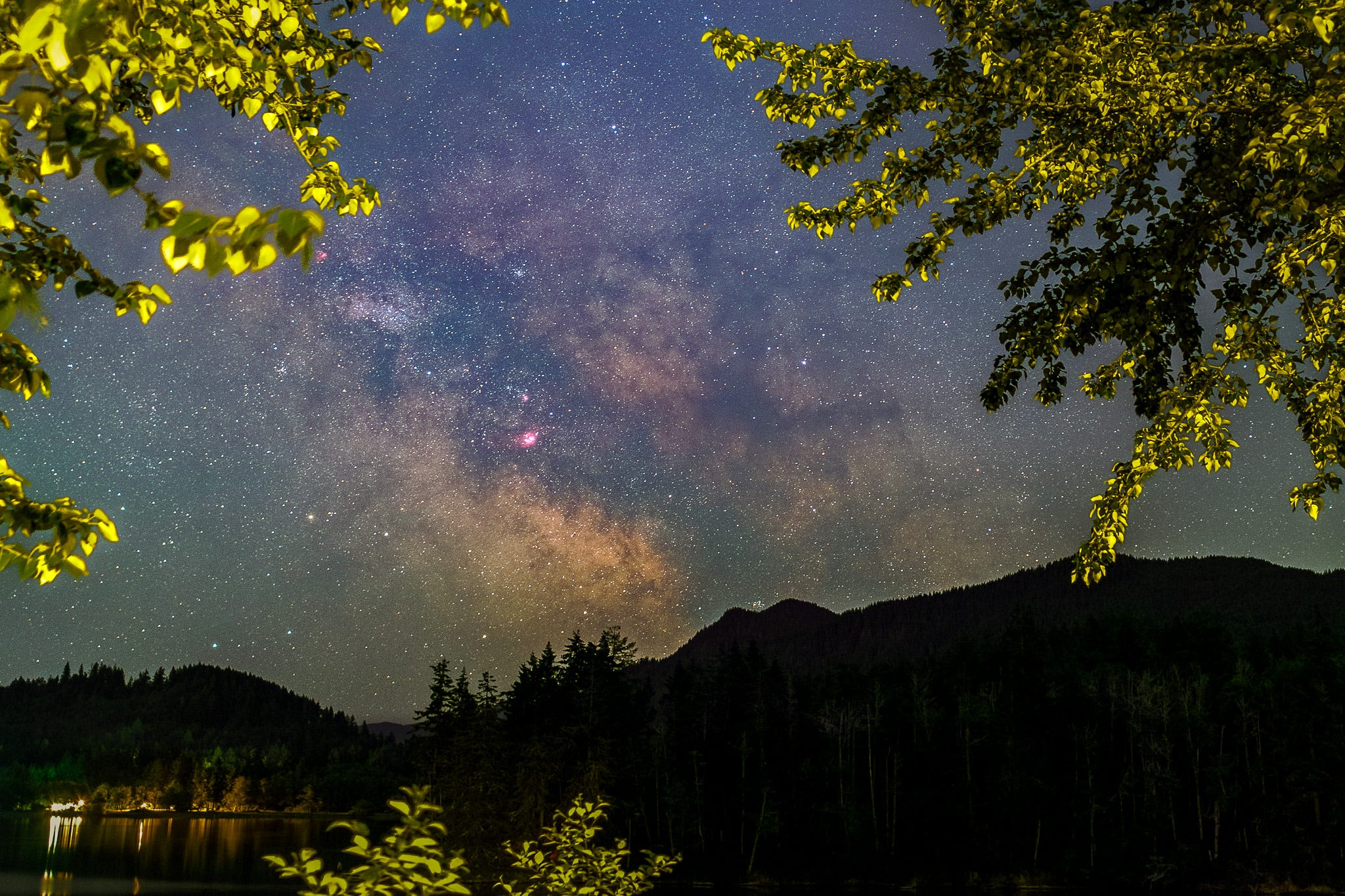
Two campsites away there was a small gap in the trees, and using the night augmented reality function on my planning app (PhotoPills), I could see that the Dark Horse nebula and galactic center would be visible there around 11:30—during astronomical twilight, but not full dark. After dinner and a movie (did you know you can download from Netflix to your computer before heading off into the wilds of trailer camping?) I went outside to find that there were 3 bright orange tinted “street lights” in the campground, which lit up all the foliage on the tree branches. I thought the photo shoot would be a bust, but with some careful tripod positioning and heavy cropping (goodbye warning signs and chainlink), I created an image I’m proud of. This photo is actually 10 photos taken back-to-back and stacked in computer software that removes pixels that are not the same photo-to-photo, which means it removed thje distracting satellite trails and plane lights, of which there were plenty.
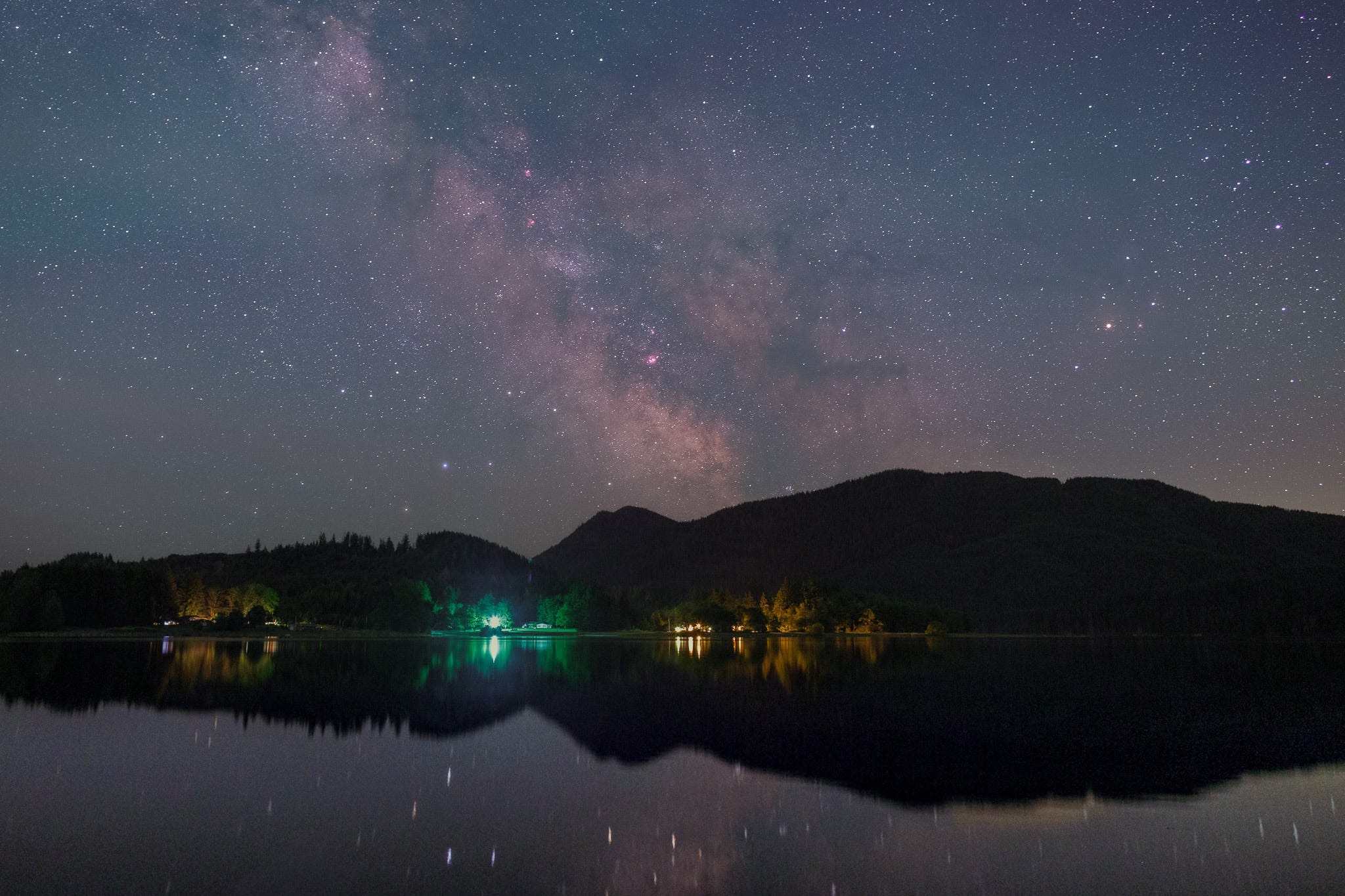
The next night, with park ranger permission, we walked past the locked gate into the day-use area to a spot I’d scoped out in the light the day before. When I’d arrived on foot I came from a pedestrian path, walking 10 minutes from our campsite, entering in a completely different location. In the dark I didn’t recognize anything, so we made an extra long loop around the park looking for the location where the Milky Way would be making its appearance. The lake isn’t wide there, and a house across the way had a very bright green light that ruined the whole vibe for me, though it might have lit up the beach nicely for them. Editing the photo, I tried to tone down the green in Lightroom, and wasn’t successful. (Someday I’ll learn enough Photoshop to try to fix a problem like this with that app.)
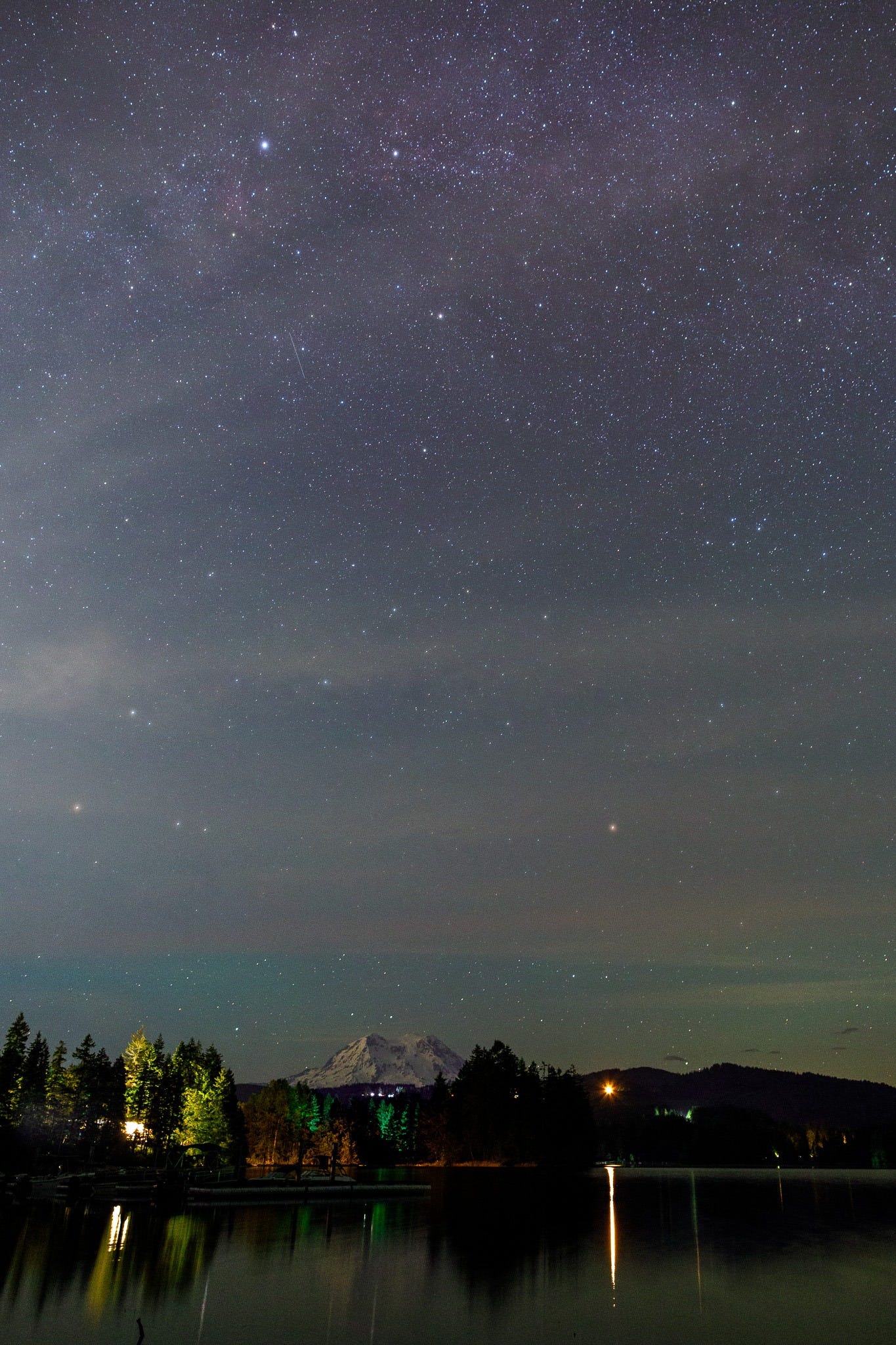
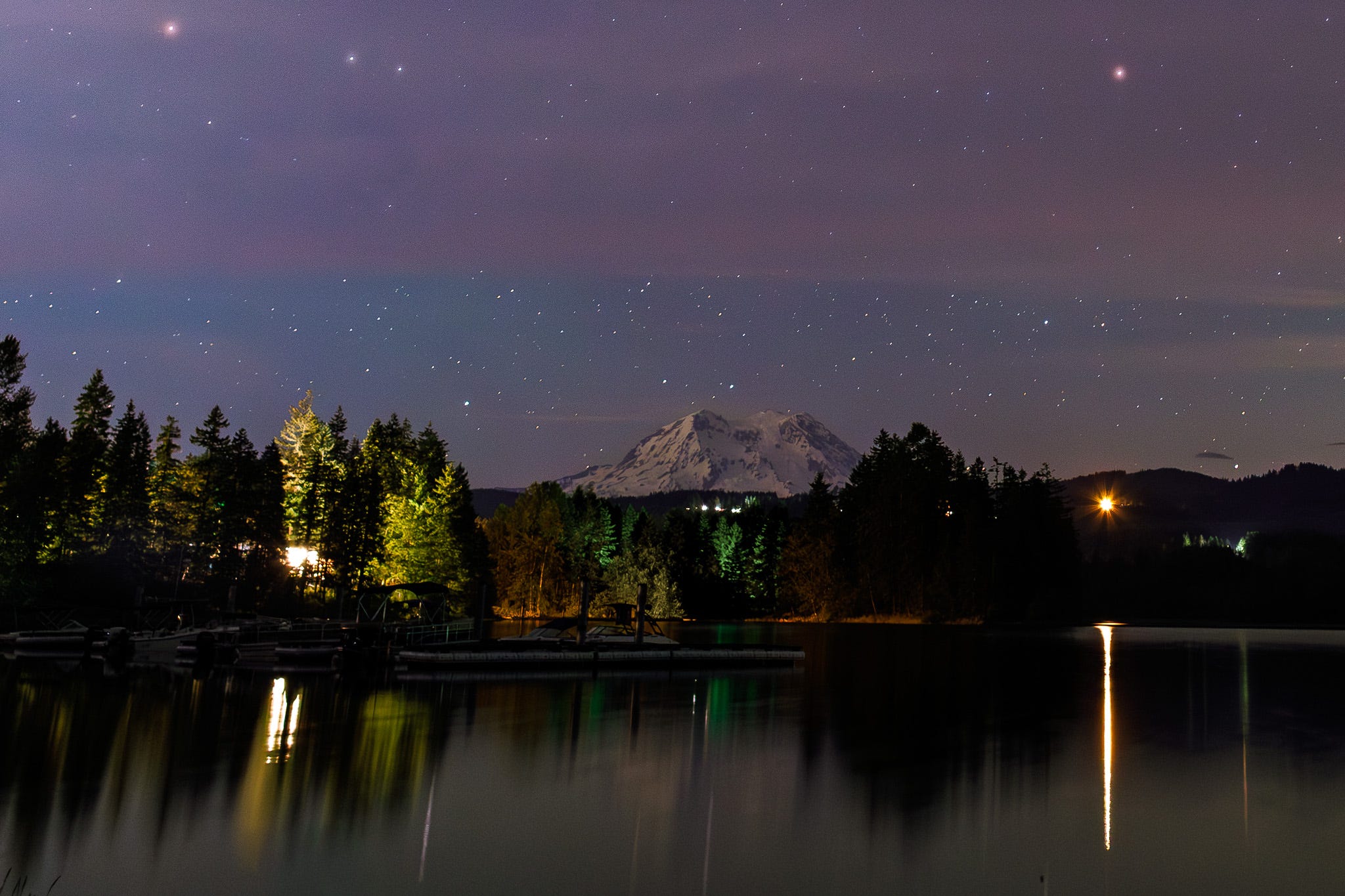
The Milky Way still has a bit of an arch while rising right now, and in taking a panorama, I discovered that Mt. Rainier was visible at the far end of the lake. The Milky Way arch was faint that far east and mixed with clouds (the mountain can create its own weather). There was, however, beautiful green and pink ripples of air glow, an aurora-like phenomenon in the sky. And even though there was also artificial green light, the scene was, to quote Bob Ross, a “happy accident,” and my favorite composition of the night.
Thanks for sharing my first Milky Way sighting of the year with me. Wishing you clear skies and beautiful nights as we approach the summer solstice!